The True Cost of Inadequate Worker Accommodations on Job Sites
January 5, 2026
Essential Infrastructure for Remote Construction Site Camps
February 12, 2026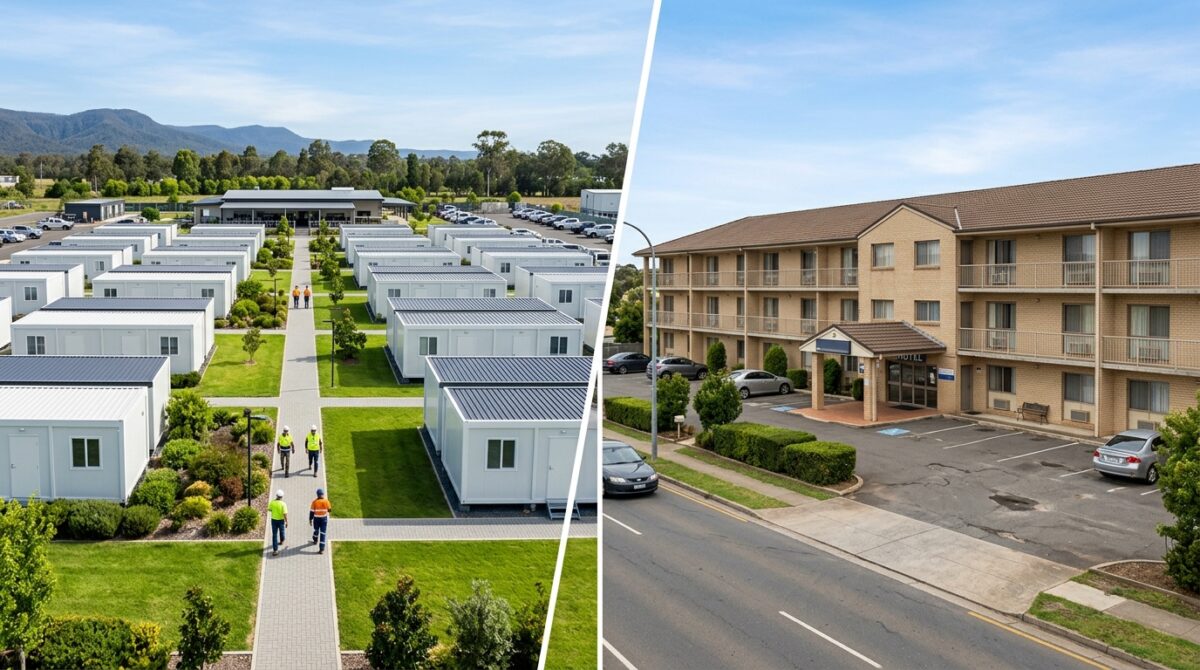
When a construction project requires relocating workers to a remote or semi-remote area, project managers face a fundamental decision: house the crew in local hotels or deploy a purpose-built workforce camp. While hotels may seem like the simpler choice, a thorough cost-benefit analysis almost always favors turnkey workforce camps for projects exceeding 50 workers or 3 months in duration.
This analysis breaks down the financial, operational, and strategic factors that should drive your accommodation decision.
Direct Cost Comparison
Let’s start with the numbers. For a project requiring 200 workers over 9 months in a mid-sized town near a remote work site:
| Cost Element | Hotel Option | Turnkey Camp |
|---|---|---|
| Nightly accommodation | $139/night × 200 × 270 days = $7.5M | $75/day × 200 × 270 days = $4.05M |
| Per diem (meals) | $65/day × 200 × 270 = $3.51M | $45/day × 200 × 270 = $2.43M (on-site kitchen) |
| Transportation to site | $25/day × 200 × 270 = $1.35M | $5/day × 200 × 270 = $270K (on-site or adjacent) |
| Mobilization/demobilization | $0 | $350K |
| Site preparation | $0 | $200K |
| Total direct cost | $12.36M | $7.30M |
| Per worker per day | $229 | $135 |
The turnkey camp delivers a 41% cost savings—$5.06 million—in direct costs alone. But the indirect benefits are equally compelling.
Productivity and Schedule Impact
The hotel model introduces daily productivity losses that compound over the project lifecycle:
- Commute time: Hotel-to-site travel averages 30-60 minutes each way. That’s 1-2 hours of paid time daily where workers are sitting in buses, not working. Over 270 days, 200 workers lose 54,000-108,000 productive hours.
- Morning mobilization: Coordinating bus schedules for 200 workers across multiple hotels means staggered arrivals and slow morning starts. On-site camps enable synchronized shift starts.
- Fatigue and distraction: Workers in shared hotel rooms with thin walls, unreliable Wi-Fi, and no recreational facilities experience more sleep disruption and lower morale.
- Meal quality: Per diem often leads to fast food and convenience store meals. On-site kitchen and dining facilities provide nutritionally balanced meals that sustain energy throughout demanding shifts.
Industry studies estimate that on-site camps improve effective productivity by 12-18% compared to hotel-based crews. On a $100M project, even a 5% productivity improvement translates to $5M in value.
Availability and Reliability Risks
Hotel-based strategies carry risks that don’t appear in initial cost projections:
- Room availability: In boom areas (Permian Basin, Bakken, Appalachian gas fields), hotel capacity evaporates quickly. Rooms that cost $89/night at booking may be $189/night six months later—if available at all.
- Competing projects: When multiple large projects ramp up simultaneously, every contractor is competing for the same hotel rooms. Late entrants face severe shortages.
- Seasonal events: Hunting season, festivals, or college football games in rural areas can temporarily eliminate available rooms, forcing last-minute scrambles.
- Quality inconsistency: Spreading workers across multiple hotels means inconsistent room quality, different breakfast options, and complex logistics coordination.
A dedicated workforce camp eliminates these variables entirely. Your capacity is guaranteed, your costs are locked in, and your logistics are simplified.
Workforce Retention and Recruitment
Experienced tradespeople increasingly evaluate potential projects based on accommodation quality. Here’s what workers value—and how each option compares:
| Worker Priority | Hotel | Turnkey Camp |
|---|---|---|
| Private room | Usually shared (2 per room) | Semi-private or private options available |
| Reliable meals | Per diem (self-managed) | 3 prepared meals daily, snack bar |
| Laundry | Limited hotel machines | Industrial laundry facilities |
| Recreation | Varies by hotel | Dedicated recreation facilities, gym, outdoor areas |
| Wi-Fi reliability | Varies widely | Enterprise-grade connectivity |
| Commute to site | 30-60 min each way | Walk or short shuttle ride |
| Community feel | Isolated in hotel rooms | Crew camaraderie, shared spaces |
Workers on well-managed camp projects report higher satisfaction scores and are more likely to accept future assignments with the same contractor. In today’s skilled labor shortage, this retention advantage has real dollar value.
Safety and Compliance Advantages
On-site camps offer significant safety benefits:
- Eliminated road risk: Daily bus commutes on rural highways are statistically dangerous. Vehicle accidents are the leading cause of workplace fatalities in construction. Every mile of commute you eliminate reduces risk.
- Controlled environment: On-site camps can enforce alcohol and drug policies, curfews, and check-in/check-out procedures that hotels cannot.
- Emergency response: Medical emergencies at 2 AM are handled on-site with trained staff, not dependent on hotel front desk personnel calling 911.
- Fatigue management: Workers sleeping 200 feet from their work site get more rest than those facing a 45-minute bus ride after a 12-hour shift.
When Hotels Actually Make Sense
To be fair, there are scenarios where hotel accommodations are the better choice:
- Small crews (under 30 workers): The mobilization cost of a camp doesn’t justify itself for small teams.
- Short duration (under 8 weeks): Camp setup and teardown time makes hotels more practical for very short projects.
- Urban locations: When the work site is in a city with ample hotel supply and short commutes, the camp advantage diminishes.
- Specialized workers: Engineers, inspectors, or management staff making short visits may prefer hotel flexibility.
Making Your Decision
The decision framework is straightforward:
- 50+ workers, 3+ months, 30+ miles from town: Turnkey camp is almost certainly the right choice.
- 100+ workers, any duration over 2 months: Camp economics are compelling.
- Any size, truly remote location: Camp is the only practical option.
RIM Camping provides comprehensive turnkey workforce camp solutions that handle every aspect—from site assessment and permitting through daily operations and final demobilization. We work with your team to model the total cost of ownership for both options, ensuring you make the decision that best serves your project’s needs and budget.
The data consistently shows that purpose-built workforce camps deliver lower total cost, higher productivity, better safety records, and stronger worker retention. For most large construction projects, the question isn’t whether you can afford a turnkey camp—it’s whether you can afford not to have one.